
While the traditional construction industry has spent years battling labor shortages, supply chain disruptions, and the grueling pace of manual labor, a quiet yet irreversible tectonic shift has occurred in Houston. Long associated with space exploration and oil derricks, the city has suddenly emerged as America’s premier proving ground—where the future of residential architecture is forged not with trowels and scaffolding, but along the millimeter-precise trajectories of robotic arms.
Here on the sweltering Texas Gulf Coast, buildings must be more than just aesthetically pleasing—they have to withstand the crushing forces of hurricane winds and torrential rains. Under these conditions, 3D concrete printing has stepped out of research labs and straight onto active construction sites. These are no longer futuristic concept renderings or temporary pavilions. Houston has defied traditional building dogmas, proving that robotics, aerospace-grade LiDAR scanning, and additive manufacturing can erect two-story monolithic structures in a matter of days. This shift is fundamentally redefining how—and from what—the modern American Dream is built. Below, we take a closer look at this groundbreaking trend in Houston at houston-future.com.
3D Printing Pioneers: From Experiments to Two-Story Homes
Houston has officially carved out its place in American architectural history, shattering the long-standing stereotype that construction inevitably requires armies of laborers, rumbling cement mixers, and months of dust. It was here that the first two-story residential home in the United States completely printed by a construction robot was built, covering more than 370 square meters (over 4,000 square feet). This is far from a mere showcase mockup—it is a bold manifesto of how the era of additive manufacturing is actively reshaping the American Dream.
How the Construction Printer of the Future Works
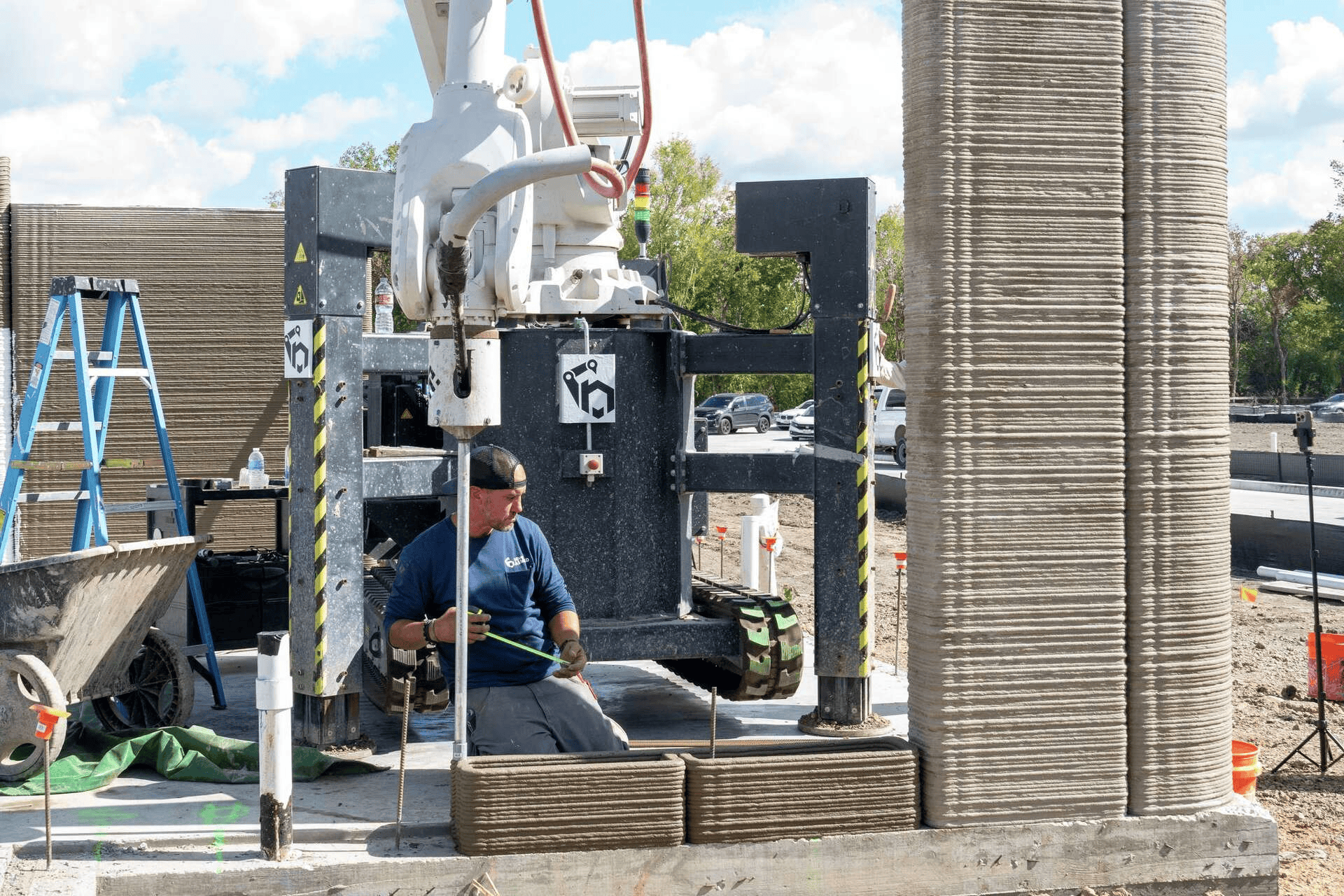
- Giant gantry robots on site. Instead of standard crews with trowels, a massive gantry system deploys to the jobsite. Guided by a digital 3D model, the robotic manipulator extrudes a specialized, high-viscosity cementitious mixture layer by layer, building complex architectural geometries with pinpoint accuracy.
- Material symbiosis: the hybrid frame. Engineers have bypassed the impulse to 3D-print every single element. The secret to structural integrity and cost-efficiency lies in pairing a printed concrete core with conventional steel beams and wood framing. This gives the building essential ductility while preserving monolithic durability.
- A breakthrough in speed and logistics. The most striking advantage is construction velocity. Erecting load-bearing walls—a task that previously took months of labor-intensive work—now takes mere days, slashing on-site manual labor needs by a remarkable 50% to 60%.
Behind Houston’s first two-story 3D-printed house lies much more than an appetite for spectacle—it is driven by hard-nosed pragmatic calculation. Construction automation provides a direct answer to chronic labor shortages and volatile building material costs. Houston has proven once again that the future of architecture is forged where daring engineering meets the willingness to put it to the test in the field.
Jobsite Robotics: Setting New Standards in Construction
While 3D printers handle the heaviest structural geometry, Houston developers are outfitting the rest of the jobsite with a fleet of autonomous assistants. The era when construction was strictly defined by grueling, hazardous manual labor is rapidly fading. Today, a new standard is emerging across Texas projects, where robotics and digital algorithms take on the most repetitive, dangerous, and precision-demanding tasks.
The Digital Vanguard of the Jobsite
- Robotic assistants and exoskeletons. Backbreaking manual finishing is making way for compact, high-precision robots that autonomously screed floors, apply plaster, and install surfaces with microscopic tolerances. Construction workers are shifting from manual laborers to system operators, while passive and powered exoskeletons relieve strain on the spine and joints, making heavy lifting both safe and effortless.
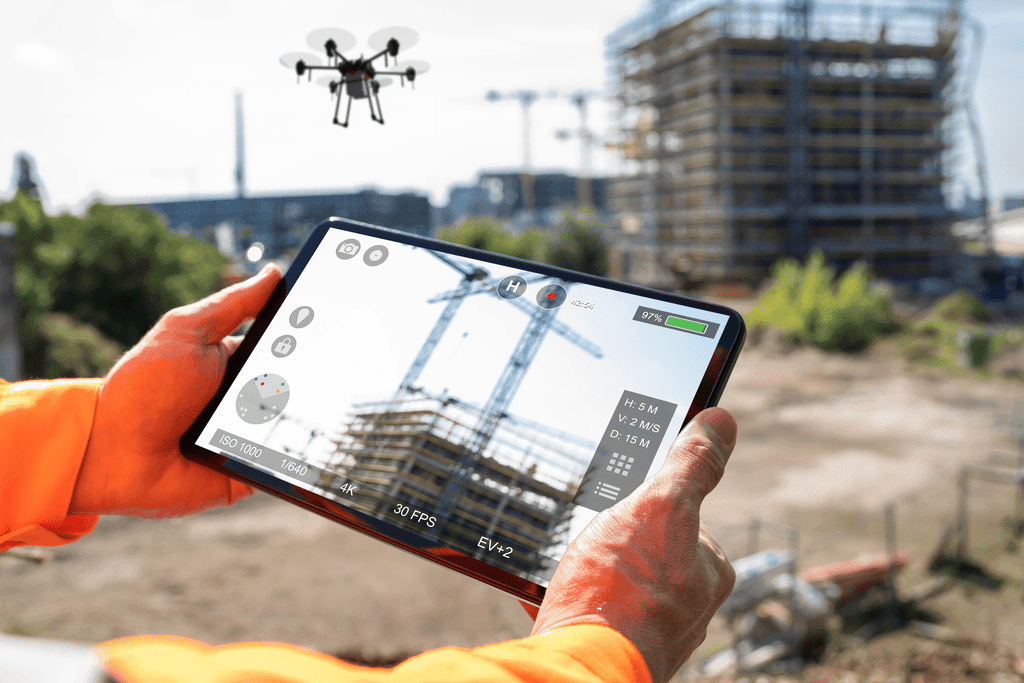
- Drones and real-time LiDAR scanning. The airspace above jobsites is monitored by autonomous drones outfitted with high-precision laser sensors and optics. Daily scans cross-reference real-world progress against the building’s 3D digital twin in real time. This spots even the smallest survey deviations during assembly, eliminating costly rework down the road.
Integrating autonomous machinery and aerospace-grade inspection protocols turns Houston construction sites into high-tech assembly lines. This is not merely about trimming overhead—it creates an entirely new work ecosystem where human safety and uncompromising engineering precision are the primary benchmarks.
Climate Resilience: Monolithic Concrete vs. the Texas Elements
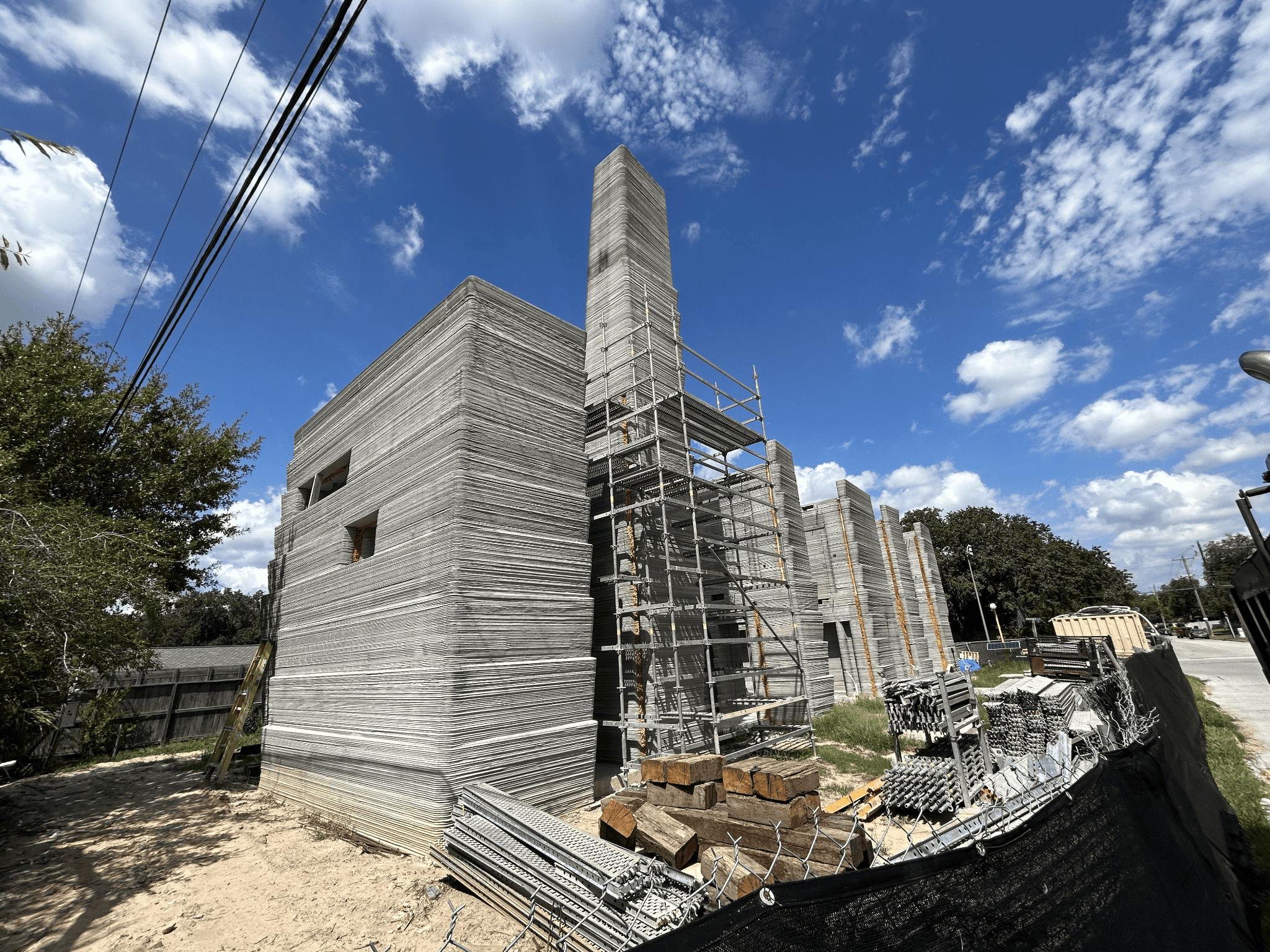
Along the Texas coast, where seasonal hurricanes and sudden tropical deluges put infrastructure to the test, architecture has long ceased to be just about aesthetics. Here, it is quite literally a matter of survival. The lightweight wood-and-plywood frame houses traditional to the American South struggle to withstand increasingly aggressive storm patterns. Against this backdrop, monolithic 3D-printed structures demonstrate remarkable structural resilience, setting new fortified standards for Houston’s residential neighborhoods.
Concrete Armor
- Uncompromising storm resilience. The seamless, continuous envelope extruded by the printer transforms the house into a single structural monolith. These buildings easily withstand sustained winds topping 250 km/h (155 mph)—matching the destructive thresholds of Category 4 and 5 hurricanes that easily collapse conventional stick-frame homes.
- Impervious to moisture and extreme heat. Unlike timber or drywall, proprietary high-density concrete mixes do not absorb water, rot, or foster mold growth even after standing floodwaters recede. In addition, concrete’s high thermal mass acts as a natural buffer against oppressive Texas heat, significantly easing the load on HVAC systems and lowering energy bills.
Deploying additive manufacturing in coastal zones proves that 3D concrete printing is far more than an eccentric novelty—it represents one of the few viable answers to our evolving climate reality. Houston is pioneering housing designed to endure where conventional building methods buckle under nature’s forces.
Challenges and Prospects of Robotic Neighborhoods
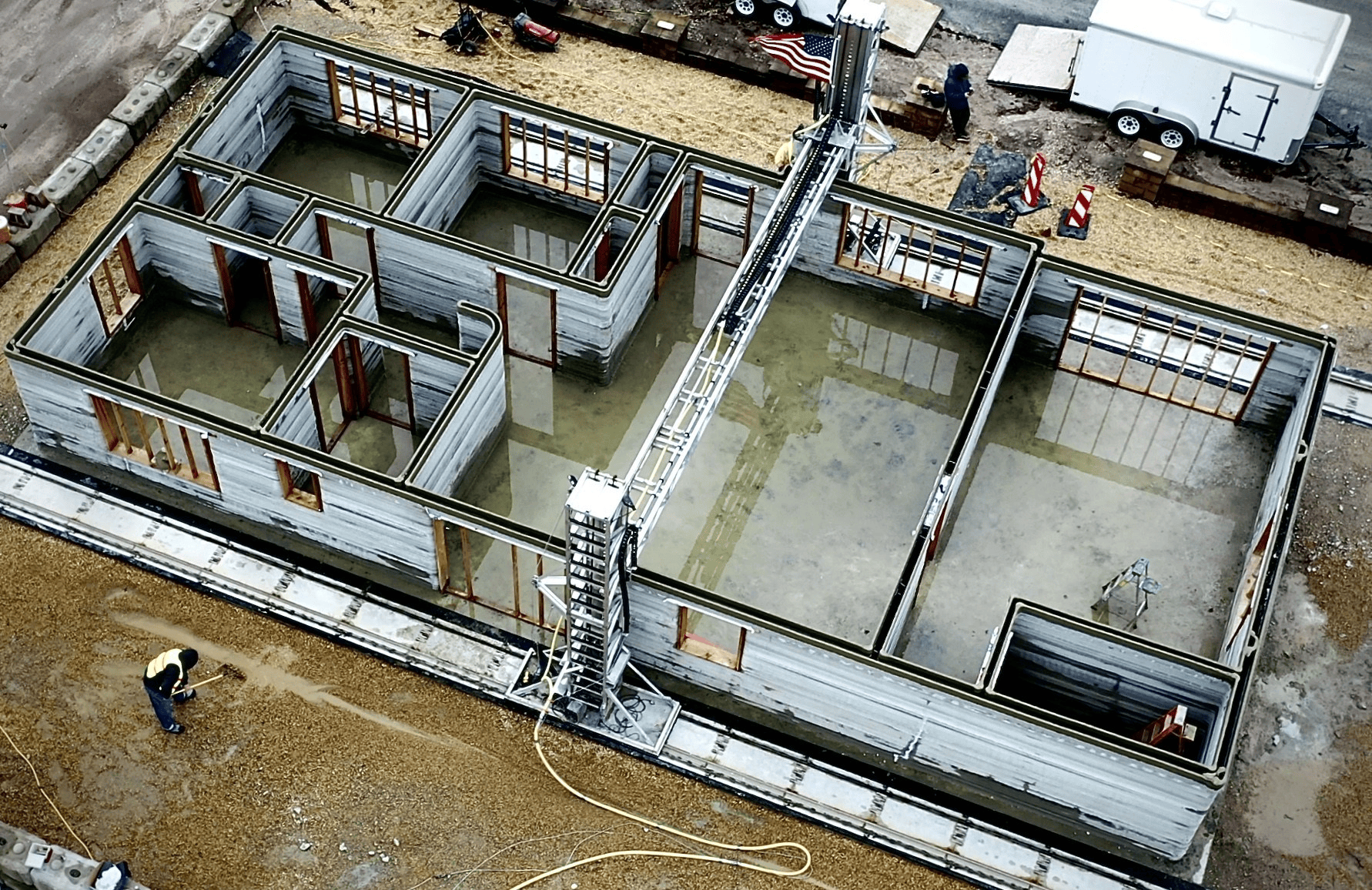
Scaling additive construction from standalone showcases to complete robotic subdivisions in Houston still encounters very real practical hurdles. The primary bottlenecks remain the steep upfront capital expenditure for large-scale gantry printers and an entrenched regulatory landscape. Local municipal building codes were drafted over decades around conventional wood-frame and brick methods, and they are struggling to keep pace with rapid developments in automated engineering.
Yet this is merely a temporary pause ahead of a major technological leap. The rapid development of low-carbon geopolymer concretes, coupled with streamlined statewide certification pathways, is steadily clearing the way for mass adoption. Houston is making decisive strides toward entire subdivisions of accessible, energy-efficient, and ultra-resilient next-generation homes—where humans articulate the vision and intelligent machines cast it in concrete.

