

The Rice Hotel was a landmark building for Houston throughout the 20th century. Presidents stayed within its walls, and many innovations were first introduced here. The Rice frequently changed owners, and it’s rumored that the ghosts of former staff haunted its basements. The building witnessed numerous historical events and holds secrets that are sure to surprise you. Read on at houston-future to uncover them.
The Texas Capitol
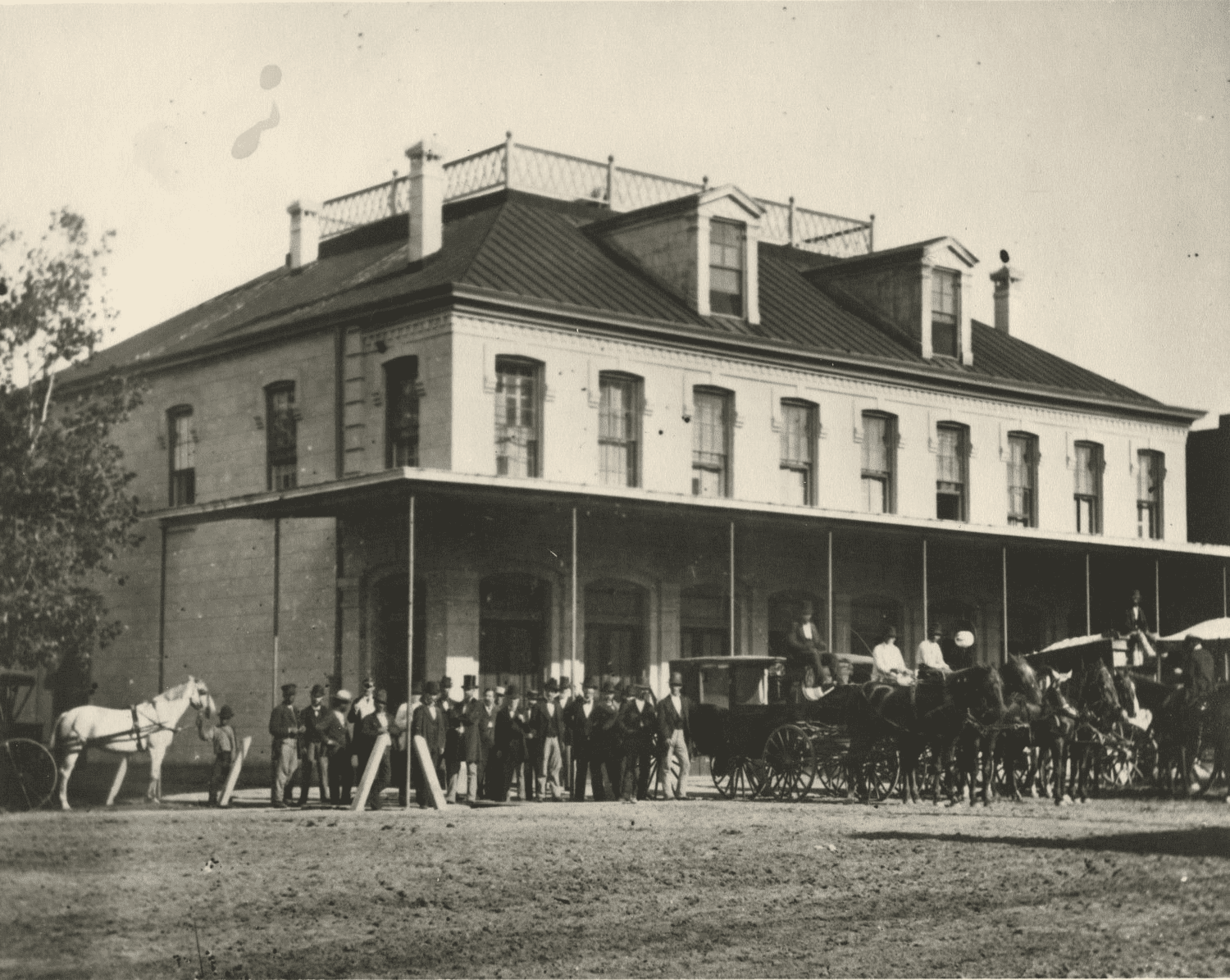
After founding the city, the Allen brothers had an ambitious plan: to make Houston the state capital. When developing the blueprint for the future center of Texas, a prominent place in the master plan was reserved for the government capitol building. They were so eager to realize their dreams that the still-young, developing city soon had a government building of considerable size.
And the Allen brothers’ plans came to fruition. For two years, beginning in 1837, the government of the Republic of Texas used the newly constructed building as its capitol. Later, when the capital was moved to Austin, the building was leased by a certain Mr. Norwood, who turned it into a hotel. The new lessee didn’t overthink the name, simply calling it the Capitol, a familiar name to the city’s residents. Apparently, the hotel business didn’t go too well, as the building had several different operators between 1841 and the early 20th century. The establishment’s name also changed, being known at times as the Houston House and the Barnes House.
It is also known that the wife of one of the founding brothers, Charlotte Allen, held the property rights to the hotel. There are accounts that the couple frequently argued over the building, and it may have even been a cause of their divorce.
The Masonic Lodge
After these twists and turns, the hotel building caught the eye of the city’s powerful elite. In the late 19th century, the building was leased for the use of the Holland Lodge. The Masons held their meetings, ceremonies, and events there, making the hotel a center of Masonic activity in the region. The building became a mecca for influential politicians and successful businessmen who were members of the Masonic brotherhood.
This activity eventually led to the location becoming the founding place of the Grand Lodge of the Republic of Texas. This fraternity included such famous figures as Sam Houston, Anson Jones, and William Marsh Rice. Incidentally, Anson Jones, the last president of the Republic of Texas and the first Grand Master of the Texan Masons, committed suicide in this very hotel in 1858. This unexplained suicide and the secrecy of Masonic rituals gave rise to an urban legend that the Capitol Hotel was a paranormal site with a significant “energetic footprint.” These rumors didn’t even subside after the building was demolished, and the hotel’s mystical reputation continued to live on among Houstonians. We will return to this below.
One of the Lodge’s members, William Marsh Rice, who was also a local tycoon, purchased the Capitol Hotel in 1886. And it was at this moment that the era of the Rice Hotel truly began.
The First Building
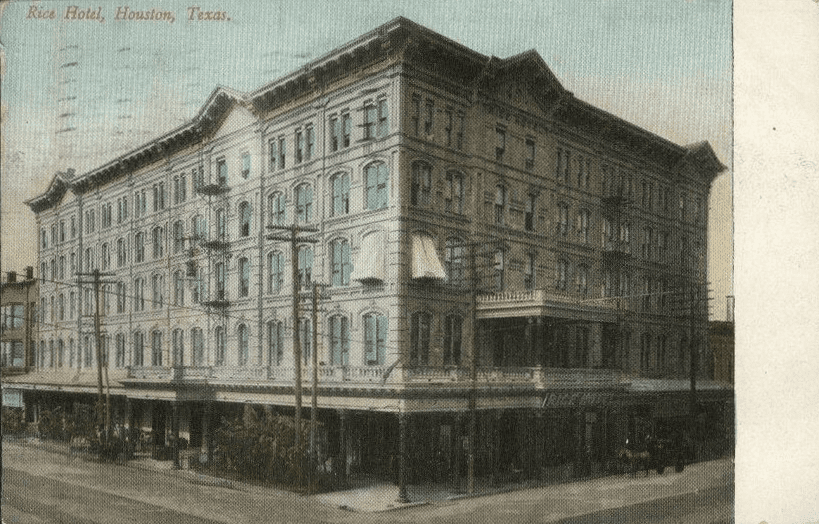
Let’s take a step back in our retrospective to note that in 1881, the owner of the first building was Abraham Groesbeck. He bought the property rights from Charlotte Allen and tore down the former structure. On the site of the former government building and favorite haunt of Texas Masons, he erected a handsome five-story hotel in the Victorian style. The building was designed by the fashionable architect of the time, George Dickey, who had recently moved to Houston. It was the city’s first skyscraper.
But Groesbeck didn’t get to enjoy his status as the owner of a luxurious hotel for long. He died in 1886, adding even more mystery to the hotel’s paranormal aura. After his death, the building was acquired by the Mason we already know, William Marsh Rice. He immediately began renovating the hotel, adding three more floors. Just as the building was being put back into service, Rice was murdered in 1900. The mysterious deaths of its owners once again became the talk of Houston.
Be that as it may, William Rice was a well-known philanthropist in the region, having founded the Rice Institute in Houston. Therefore, after his death, the hotel property was transferred to the institute. The institute’s trustees renamed the hotel in honor of their patron. And so, the Rice Hotel was born.
Rebirth of the Hotel
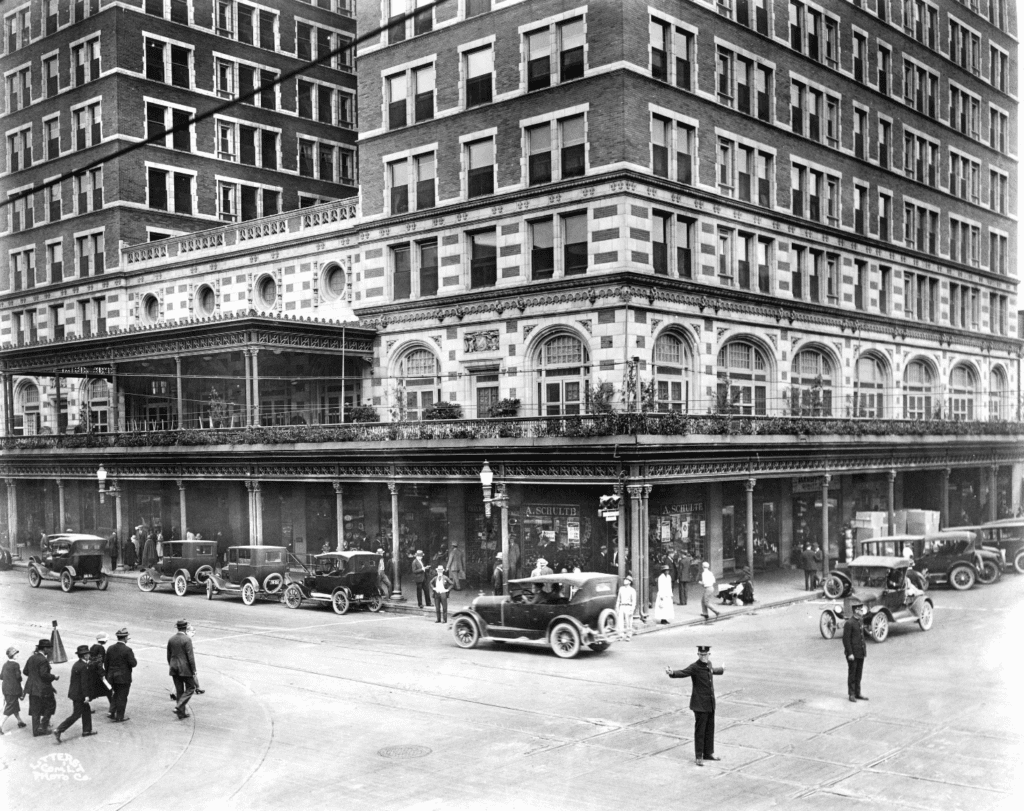
Due to its mystical reputation and sanitation problems, the hotel began to decline. City developer Jesse Jones took on the seemingly hopeless project. In 1913, a magnificent new structure appeared in the center of Houston. This was the phenomenal Rice Hotel. It was a hotel of superlatives: at the time, it was the tallest building in Houston, the largest hotel in the South, and offered the most comfortable accommodations. The building was constructed in a C-shape and had 18 floors. It featured the region’s first open-air rooftop terrace, which became a popular spot for locals and visitors alike. The Rice Hotel also boasted the first air-conditioned public space. The true gem of the establishment was the Crystal Ballroom, which never lacked for visitors.
In 1925, a third wing was added, increasing the number of rooms to over 1,000 and creating the current E-shaped configuration. A swimming pool was also built in the basement. For a long time, the hotel was Houston’s most popular dance venue.
Its fame as the most fashionable hotel lasted until the 1970s. After Jesse Jones’s death in 1956, all rights to the hotel passed to the Houston Endowment, which then transferred them to the Rice Institute. Gradually, business declined, and the establishment became unprofitable. Due to its lack of profitability, it was closed in 1977.
Interesting Facts About the Hotel
- Six U.S. presidents stayed at the Rice Hotel.
- John F. Kennedy spent his last night at this very hotel. Coincidentally, his assassin, Lee Harvey Oswald, also stayed there around the same time.
- To lure the 1928 Democratic National Convention to Houston, Jesse Jones spent $200,000. A special covered pavilion was built on the roof for the event.
- There were underground tunnels beneath the building that connected the hotel to other historic buildings in the city.
- William Marsh Rice was poisoned by his valet, Charles Jones, in a conspiracy with lawyer Albert Patrick. This story became a sensation in the early 20th century.
- In 1962, the Rice Hotel was used for a meeting of NASA’s Astronaut Group 2.
- Throughout its existence, the hotel was associated with paranormal phenomena, linked to the tragic deaths of its owners and the activities of the Masons.
The Rebirth of an Icon
After its roaring success in the early part of the century, the hotel was declared unprofitable and shut down in 1977. For 22 long years, the once-bustling premises remained abandoned and closed. The Rice Hotel stood like a ghost in the center of Houston. It wasn’t until 1998, after legal battles and formal proceedings, that the property was sold to a private developer.
The building remained in limbo for a long time, as some members of the Rice Institute’s board of trustees protested its transfer to private ownership, citing its historical and cultural value. Once these disagreements were resolved, finding funds for reconstruction was a struggle. Finally, in April 1998, the reopening and renaming of the building as the Rice Lofts was announced. It was no longer a hotel. The building was converted into a residential complex with 312 apartments. After remodeling and major renovations, the cost to rent a one-bedroom apartment in the Rice Lofts is between $1,500 and $1,700.
Public establishments operate on the ground floor. Among the most famous is the Sambuca jazz club. The open terraces and pool continue to evoke the past glory of the legendary Rice Hotel.